How to Fix a Flat Wheelbarrow Tire at Home
To fix a flat wheelbarrow tire, remove the wheel, find the leak, and patch or replace the tube if the tire and rim are sound. If they aren't, choose a compatible replacement wheel.
On this page (10 sections)
- How do you fix a flat wheelbarrow tire?
- How can you tell whether a wheelbarrow tire is pneumatic?
- How do you find a puncture in a wheelbarrow tube?
- When should you patch the tube or replace the wheel?
- What tools do you need to fix a wheelbarrow flat?
- How do you choose a replacement wheel for a flat tire?
- How do you reinstall the wheel after a tube repair?
- How can you reduce repeat flats?
- Should you repair the tube or replace the wheelbarrow tire?
- Related guides
To fix a flat wheelbarrow tire, remove the wheel, locate the leak, and patch or replace the tube if the tire casing and rim are sound. If the casing is split, the rim is bent, or air keeps escaping, replace the damaged part or complete wheel.
Start by identifying the tire type. A pneumatic tire holds air and may have a tube to repair; a flat-free tire uses solid or foam-filled material and has no air chamber.
How do you fix a flat wheelbarrow tire?
Take the wheel off, remove the tube, find the leak, then patch or replace it. Work with the tray empty on firm, level ground, and follow the patch kit's instructions.
- Tip the wheelbarrow so the tire is clear of the ground and the frame is stable. Use a solid support if needed.
- Inspect how the axle is secured. Remove clips, nuts, washers, or spacers, and keep them in order.
- Slide off the wheel, noting which way the hub faces and where each spacer sits.
- Let out any remaining air. Separate the tire bead from the rim with tire levers or another tool made for that job.
- Ease out the tube without tugging the valve. Notice how the valve sits through the rim.
- Add only enough air to give the tube shape. Find and mark the leak.
- Check the tire inside and out for a thorn, shard, or other cause. Remove anything sharp carefully.
- Patch the tube if the hole is within the kit's limits and the tube is otherwise sound. Replace it if the damage is too large or near a damaged valve.
- Refit the tube and tire, inflate gradually to the pressure marked on the tire, and reinstall the wheel with its original hardware.
If the axle is bent, the wheel is stuck, or the rim has a sharp damaged edge, fix that problem before using the wheelbarrow again. For a full assembly swap, see how to replace a wheelbarrow wheel.
How can you tell whether a wheelbarrow tire is pneumatic?
A pneumatic tire has an air valve and compresses when pressed; a flat-free tire has no air chamber to inflate. Check the sidewall and wheel before reaching for a pump or patch kit.
A valve stem is a useful clue, but it doesn't prove that the tube is repairable. The tube, casing, valve, or rim may still need replacement.
Flat-free wheels avoid pressure checks and tube punctures, but a damaged one must be replaced with a compatible assembly. Compare the tradeoffs in how to foam fill a wheelbarrow tire.
How do you find a puncture in a wheelbarrow tube?
Check the tread side, sidewalls, valve, and rim area for escaping air. If you can't hear the leak, brush soapy water over the tube and look for bubbles.
Remove the tube from the tire before inspecting it closely. Move around the tube slowly, and mark the leak as soon as you spot it.
A damaged valve, a long tear, or several holes usually calls for a replacement tube. Check the inside of the tire where the tube was punctured, since a sharp object left in the casing can cause another leak.
Don't overinflate a loose tube. Without the tire casing around it, the tube can expand too far.
When should you patch the tube or replace the wheel?
Patch a small puncture if the tube, casing, and rim are still in good shape. Replace the tube or full wheel when damage is extensive, keeps returning, or makes the assembly unsafe.
Use a patch kit that fits the tube and puncture, and prepare the surface as its instructions direct. Replace the tube if the valve is damaged, the rubber is split, or several leaks make a reliable repair unlikely.
A cracked or badly worn casing and a bent rim are reasons to replace the wheel assembly. If the wheel is sound and only the tube is damaged, a compatible tube may be enough.
Afterward, roll the empty wheelbarrow on level ground and check for wobble or rubbing. Before loading it, review how much a wheelbarrow can hold.
What tools do you need to fix a wheelbarrow flat?
Gather a wrench or pliers for the axle hardware, tire levers, a pump, and a compatible patch kit. Soapy water can help reveal a slow leak.
Keep the barrow empty and work on level ground. A stable support can hold the frame while the wheel is off; don't balance it on a loose stack of blocks.
Tire levers help separate the bead while reducing the chance of pinching the tube or scratching the rim. A screwdriver can damage either, so use it only if the wheel's instructions allow it.
How do you choose a replacement wheel for a flat tire?
Match the tire diameter and width, hub length, axle bore, and available frame clearance. A familiar tire-size label alone doesn't guarantee that the wheel will fit.
The TICONN 14.5-inch flat-free wheel suits a buyer who wants to stop patching tubes and checking inflation. It has a polyurethane foam tire, steel rim, stated 330 lb capacity, and included bearings and spacers; skip it if you need an air-filled ride or its hub and axle dimensions don't match.
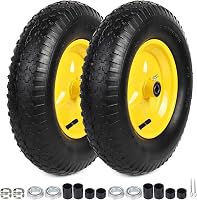
The AR-PRO pair is for replacing two wheels on equipment that fits its 15.7-inch outside diameter, 3-inch centered hub, and 3/4-inch bushings. Its pneumatic tires keep an air-filled setup, but skip the pair if you need only one wheel or your axle and hub dimensions differ.
The GICOOL 3.50-8 wheel is a single pneumatic option for a 5/8-inch axle and 6-inch centered hub. Choose it when those dimensions match and you want an air-filled tire; skip it if your wheelbarrow uses a shorter hub or another axle bore.
The smaller GICOOL 4.00-6 wheel suits a cart or wheelbarrow built for a 13-inch tire, 1.75-inch centered hub, and 5/8-inch axle bore. It includes bearings and spacers; skip it if your current wheel is a larger size or uses a different hub length.
Before ordering, measure the old wheel's outside diameter and width, the hub from end to end, and the axle bore. Compare those measurements with the frame clearance and the replacement's fit details; don't assume that a tire-size label makes two wheels interchangeable.
How do you reinstall the wheel after a tube repair?
Keep the tube inside the tire bead, then reinstall the wheel with its original spacers and hardware. Inflate gradually and check that the bead sits evenly around the rim.
Before adding air, make sure the valve passes straight through the rim and the tube isn't trapped under the bead. Add air in stages, checking both sides as the tire takes shape.
Follow the pressure range printed on the tire. Stop if the tire bulges unevenly or the bead won't seat; don't try to force it with extra pressure.
Return the wheel to the axle in its original direction. Put each washer and spacer back where it came from, secure the hardware, then spin the wheel by hand to check for rubbing.
How can you reduce repeat flats?
Clear sharp debris from the tread and keep pneumatic tires within their marked pressure range. Avoid hauling with a nearly flat tire, since the tube can shift or pinch.
Check the tread and sidewalls for cuts, thorns, and wear before heavy yard work. Remove embedded debris carefully so it doesn't work through the casing.
If punctures keep disrupting your work, a compatible flat-free wheel removes the need for inflation and tube repairs. Clean dirt and residue from the wheel after messy jobs with how to clean a wheelbarrow.
Should you repair the tube or replace the wheelbarrow tire?
Patch a sound tube with a small, repairable puncture; replace the tube or wheel when damage is broad or returns. For a replacement, choose pneumatic to keep an air-filled tire, or flat-free if avoiding punctures and inflation checks matters more.
The TICONN option is the clearest fit for someone who wants an airless replacement and whose axle and hub measurements match. The AR-PRO pair fits a two-wheel replacement job, while the GICOOL wheels suit specific hub and axle dimensions, so measure before choosing either.
Once repaired, roll the empty barrow on level ground and check that the wheel turns without wobbling or rubbing. For more flat-free guidance, compare foam filling a wheelbarrow tire.
Related guides
- Replace a wheelbarrow wheel
- Foam fill a wheelbarrow tire
- Check how much a wheelbarrow can hold
- Clean a wheelbarrow
Frequently asked questions
Can you patch a wheelbarrow tire?
Yes, if the tire is pneumatic, the tube has a repairable puncture, and the tire casing and rim are in good shape. Remove the tube, find the leak, and use a patch kit that matches the tube material and instructions.
Replace a badly damaged or repeatedly leaking tube instead.
How do you find a leak in a wheelbarrow tire?
Add air only enough to shape the tire, then listen and feel around the tread, sidewalls, valve, and rim. If the leak is hard to locate, apply soapy water and watch for bubbles.
Keep fingers clear of the rim and stop if the tire or wheel is damaged.
Can you put a tube in a flat-free wheelbarrow tire?
No. A flat-free tire uses solid or foam-filled material instead of an air-filled inner tube, so there is no tube to patch or inflate.
Check the tire type before starting; replace a damaged flat-free wheel with a compatible assembly.
How do I know which replacement wheel fits?
Measure the old wheel's outside diameter, tire width, hub length, and axle bore, then compare them with your wheelbarrow's axle and frame clearance. Tire size markings help, but matching the hub and axle dimensions is also needed for a safe fit.