Types of Wheelbarrows and Yard Carts: A Plain Guide
The main types of wheelbarrows are single-wheel and dual-wheel designs, alongside four-wheel carts and wagons. Choose by the route, load, and unloading method: one wheel turns tightly, two wheels give a wider base, and carts support the bed as you pull.
On this page (13 sections)
- Types of Wheelbarrows and Yard Carts: A Plain Guide
- What are the main types of wheelbarrows and yard carts?
- How does a single-wheel wheelbarrow work?
- What changes with a dual-wheel wheelbarrow?
- How is a garden cart different from a wheelbarrow?
- When does a dump cart make sense?
- Who should choose a multi-use hauler?
- How should you choose between the types of wheelbarrows?
- What should you check before choosing?
- How do you set up and use a wheelbarrow or cart?
- How do you care for a wheelbarrow or yard cart?
- What mistakes should you avoid when choosing?
- Which type should you pick?
Types of Wheelbarrows and Yard Carts: A Plain Guide
The types of wheelbarrows differ in steering, support, and how you unload them. A single-wheel barrow turns tightly, a dual-wheel model has a wider base, and a garden cart or wagon supports its bed as you pull.
For a narrow path and close steering, start with a wheelbarrow. For hauling across open ground, consider a cart or wagon; for frequent loads of loose material, look for a bed that tips.
What are the main types of wheelbarrows and yard carts?
The main types are single-wheel wheelbarrows, dual-wheel wheelbarrows, garden carts, wagons, and dump carts. Wheel layout affects turning and balance, while the handle determines whether you lift and steer or pull the load.
| Type | How it moves | A good fit for | Main trade-off |
|---|---|---|---|
| Single-wheel wheelbarrow | You lift the handles and steer one front wheel | Narrow paths and close control | You support and balance the handles |
| Dual-wheel wheelbarrow | You lift the handles while two front wheels roll | A wider support base under a barrow tub | Its wider stance needs room to turn |
| Garden cart | You pull a handle with the bed supported by wheels | Routine hauling around a yard | The bed may be wider than a barrow |
| Garden wagon | You pull a longer bed, often with four wheels | Plants, tools, and mixed yard loads | A long bed needs room to turn |
| Dump cart | You pull or tow a bed that tips to unload | Loose soil, mulch, or gravel | The tipping design needs storage space |
These categories overlap. Some carts tip, some wheelbarrows have two wheels, and multi-use designs can switch between hauling tasks.
Choose by tracing the actual route from loading point to destination. A narrow gate, a sloped path, and a long lawn each put different demands on the tool.
How does a single-wheel wheelbarrow work?
A single-wheel wheelbarrow has one front wheel and two rear handles. You lift the handles to carry part of the load and steer by turning the front wheel.
That layout can make tight turns easier and fit narrower routes than a broad cart. You must keep the handles level as you move, especially when a load shifts toward one side.
A traditional barrow suits soil, stone, mulch, or garden waste when its tray and load rating fit the task. Steel trays are a common choice for rough material, while plastic tubs are often easier to rinse clean.
The True Temper 6 Cu Ft Steel Wheelbarrow, Never Flat Tire pairs a steel tray and curved front with a single flat-free tire. The curved front is shaped for dumping and spreading, which suits jobs where you move material from a pile and distribute it at the destination.
Choose this style if your route has tight turns or you value close steering. Skip it if lifting and balancing the handles is the part of hauling you most want to avoid; a supported cart bed may suit you better.
For a closer look at steering and stability, read single wheel vs dual wheel wheelbarrow.
What changes with a dual-wheel wheelbarrow?
A dual-wheel wheelbarrow has two wheels at the front, giving the tub a wider base. You still lift the rear handles, but the two wheels offer support on both sides of the front end.
That can help steady a load while you move, but the wider stance needs room. Check gate width and the space around garden beds, trees, and corners before choosing one.
The Best Choice Products Dual-Wheel Wheelbarrow combines a plastic bin with a powder-coated steel frame. It holds up to 5 cu ft, has a 330 lb weight capacity, and uses two inflatable 14 in rubber wheels.
It suits gardeners who want a wider base under a wheelbarrow tub and have room to turn. Skip it for a route with tight gates or narrow rows where the extra width will get in the way.
Compare more options in the best dual-wheel wheelbarrows.
How is a garden cart different from a wheelbarrow?
A garden cart carries its bed on multiple wheels, so you pull it by a handle instead of lifting rear handles to balance the load. That supported bed works well for routine hauling when you have enough room to pull and turn.
Bed shape and wheel placement vary. A fixed bed suits loads you can lift or shovel out, while a dump bed can tip loose material closer to where it will be used.
A cart may be wider than a wheelbarrow, so measure gates and paths first. A supported bed also does not mean every load is easy to pull: the material, slope, and ground all affect effort.
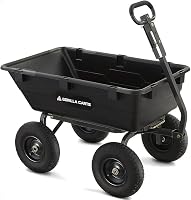
The Gorilla Carts 4 Cu Ft 600 lb Poly Dump Cart has four wheels, a 4 cu ft poly bed, and a 600 lb rating. Its quick-release dump system tips the bed, and the cart is hand-pulled rather than towable.
This cart suits a yard where you want a supported bed and a way to tip out loose loads. Skip it if you need a narrow tool for tight paths or a cart that attaches to a lawn tractor or ATV.
For more hauling options, compare the best yard carts and garden wagons with steel mesh beds.
When does a dump cart make sense?
A dump cart makes sense when you regularly need to tip loose material out of the bed. Depending on the model, you pull it by hand or tow it behind compatible equipment.
Match the unloading method to your route and work. A hand-pulled model suits short trips around a yard, while a tow-behind cart can suit a larger property if your vehicle, terrain, and turning space work together.
Bed material changes care needs. Poly does not rust, while steel should be cleaned and dried when wet or dirty to limit rust.
Think about where you will park the cart and how you will wash it after hauling wet soil, mulch, or gravel. A dump mechanism helps with unloading, but you still need space to position the cart and tip its bed safely.
The Gorilla cart described above is a hand-pulled poly dump cart. If you need a cart that attaches to equipment, compare tow-behind dump carts.
For a closer look at tub material, read steel vs poly wheelbarrow. The same questions about rust, cleanup, and the materials you carry can help you choose a cart bed.
Who should choose a multi-use hauler?
A multi-use hauler suits someone who needs one frame for several kinds of lifting and carrying. It can save space when its added functions match jobs you do often.
The WORX Aerocart 8-in-1 Wheelbarrow and Dolly has two wheels, dual support legs, and a 300 lb load capacity. It comes with a cylinder holder, bag holder, plant mover strap, and rock mover mesh, and its design can shift between hauling and dolly tasks.
Choose it if the included accessories and different carrying modes fit your regular chores. Skip it if you want a simple wheelbarrow for one job and will not use the extra functions; a dedicated barrow may be easier to choose and store.
How should you choose between the types of wheelbarrows?
Choose by route, load, and unloading method, then check capacity and dimensions. A tool that fits your largest project may feel cumbersome on everyday trips if it is too wide or difficult to steer along your path.
- Choose a single-wheel wheelbarrow for narrow routes and close steering.
- Choose a dual-wheel wheelbarrow for a wider base when your path has room to turn.
- Choose a garden cart when you prefer to pull a bed supported by multiple wheels.
- Choose a dump cart if tipping loose material is part of the job.
- Choose a multi-use hauler if you will use its different functions.
Measure your narrowest gate and tightest turn, then measure the storage spot. Write down the heaviest or bulkiest loads you expect to move and check the tool's load limit and bed volume before you buy.
For large rocks or uneven loads, read how to move heavy rocks without machinery. The load's shape and your route matter as much as its weight.
What should you check before choosing?
Check capacity, width, wheel type, handles, and unloading before settling on a design. These details tell you whether the tool fits your route and suits the work you do most.
How much capacity do you need?
Start with the materials and volume you actually move. Soil, gravel, and firewood can weigh very differently for the same bed volume, so cubic feet should not be treated as a weight rating.
Check both measures when available: volume tells you how much space the bed offers, and a weight limit sets how heavy the load can be. Our guide to how much a wheelbarrow can hold explains why the two measures answer different questions.
Will the wheels suit your path?
Pneumatic tires contain air and may roll over rough ground, but they can go flat. Flat-free tires do not need inflation; still, wheel count and placement affect how the whole tool turns and carries a load.
One front wheel favors tighter steering, two front wheels give a wheelbarrow a wider base, and four wheels support a cart bed as you pull. Consider the ground and turning space along the whole route, not just where you load the tool.
Can you store the tool?
Measure the storage space and the route into it. A model that tips upright may save floor area, while a long bed or wide wheel stance may need a larger parking spot.
Check the full dimensions, handle position, and whether the tool tips or folds for storage. Leave enough room to get it out without blocking other equipment.
How do you set up and use a wheelbarrow or cart?
Set up the tool on level ground and follow its assembly instructions before loading it. A stable start makes it easier to check that the wheels, handles, and bed are ready for the work ahead.
For a boxed barrow, lay out the hardware and match each part to the instructions before tightening everything. Check that the wheel turns freely and that the handles and legs sit firmly; recheck fasteners after the first few loads.
Load heavy material low and near the wheel or axle, and keep the load centered. Avoid stacking a high, loose pile that can shift when you turn or cross uneven ground.
Push or pull at a pace that lets you steer and stop. On a slope, keep the load manageable and avoid turning across a steep side angle; if the route feels unsafe, make smaller trips or choose another path.
For help with assembly, see how to put together a wheelbarrow from the box.
How do you care for a wheelbarrow or yard cart?
Clean the bed after hauling damp soil, compost, or other material that can cling to it. Remove residue, rinse where appropriate, and dry a steel bed before storing it to help limit rust.
Check tires before a long trip, especially if the wheel uses air. Clear mud and plant debris from around the wheels, and look over the frame, handle joints, and fasteners for looseness or damage.
Store the tool where it will not block a walkway or get knocked over. If wall storage would free up floor space, follow how to hang a wheelbarrow on a garage or shed wall.
What mistakes should you avoid when choosing?
The most common mistake is choosing by capacity alone. A larger bed is useful only if the tool fits your route, storage, and unloading needs.
- Ignoring width: a wide wheel stance or cart bed can be awkward through a narrow gate.
- Confusing volume with weight: cubic feet tell you the bed's space, not how heavy a load can be.
- Overlooking the handles: lifting a wheelbarrow and pulling a cart ask different things of you.
- Assuming every cart tips: check for a tipping bed if you need to unload loose material.
- Buying extra functions you will not use: a multi-use design earns its place when its other modes fit your chores.
- Forgetting cleanup and storage: wet material, a wide frame, or a long bed can affect where and how you keep the tool.
Make a short list of regular jobs, route measurements, and likely loads before comparing models. That turns broad product features into a practical fit check.
Which type should you pick?
Pick a single-wheel wheelbarrow for narrow routes, a dual-wheel model for a wider base, and a garden cart when you want a bed supported by wheels as you pull. Choose a dump cart if you regularly tip out loose material, and consider a multi-use hauler when you will use its extra carrying modes.
Measure your gate, path, and storage area, then match the load limit to the materials you plan to carry. If both a wheelbarrow and wagon could fit your yard, read the wheelbarrow vs wagon comparison before deciding.
Frequently asked questions
What are the main types of wheelbarrows?
The main types of wheelbarrows are single-wheel and dual-wheel models. One front wheel turns tightly and gives close steering, while two front wheels create a broader base.
Four-wheel garden carts and wagons are related hauling tools: you pull their supported beds instead of lifting handles to balance a barrow.
Is a garden cart the same as a wheelbarrow?
A garden cart is usually a four-wheel hauler with a bed and a handle you pull, while a wheelbarrow typically has one or two front wheels and handles you lift. The designs carry loads differently, so compare turning space, terrain, and unloading before choosing.
Are two-wheel wheelbarrows easier to balance?
Two front wheels provide a wider support base than one, which can help keep the tub steadier while loading and moving. The added width may make tight turns or narrow paths harder.
Compare the wheel spacing with your route, and see our guide to dual-wheel wheelbarrows.
When should I choose a dump cart?
Choose a dump cart when you regularly haul loose material and want the bed to tip for unloading. A hand-pulled cart suits yard work within walking distance; a tow-behind model may suit larger properties with compatible equipment.
Check the cart's capacity and intended use before loading it.