9 Best Solid Tires for Garden Carts (November 2026)
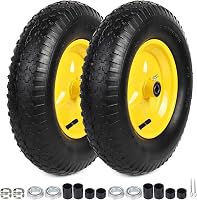
The best solid tires for garden carts include the phepetroll 4.10/3.50-4 Tires and Wheels Flat Free for most garden wagons, the Storystore 13 Inch Solid Rubber Tires for large 13 in carts, and the CANWUPON 10" Solid Tires for wide tread and grip.
On this page (8 sections)
- The best solid tires for garden carts, ranked
- How these solid tires were compared
- What size solid tire does your garden cart need?
- Which axle bore and hub offset fit your cart?
- Do solid tires ride as well as air tires?
- Which tread works best on grass and gravel?
- How many wheels should you replace at once?
- Verdict
The best solid tires for garden cart duty overall are the phepetroll 4.10/3.50-4 four-pack. It matches the 5/8 in axle on most garden wagons, ships with spacers and pins, and replaces all four wheels in one go.
Choose the Storystore 13 in set if your cart runs the larger 4.00-6 size, or the CANWUPON pack if you want the widest tread for soft ground.
Flat tires are the most common reason a garden cart gets parked for good. A thorn or a nail ends the trip, and a spare tube only helps until the next puncture.
Solid tires remove that cycle: no air, no tube, no pump.
This guide compares nine solid tire sets by size, axle fit, load rating and tread. Each one suits a different cart and a different job around the yard.
Our picks at a glance
-
1
 Best for most garden wagons
phepetroll 4.10/3.50-4 Tires and Wheels Flat Free
9.7/10 our score
See it on Amazon -
2

-
3

- 4
 Best for heavy 10 in loadsCheck it
- 5
 Check it
GICOOL 4.00-6 Flat Free Tire and Wheel
Best single replacement wheel - 6
 Check it
RRQ 4.10/3.50-4 Flat Free Tire
Best for a two-wheel swap - 7
 Check it
LTNICER 13" Flat Free Tires Compatible
Best for two-wheel yard trailers - 8
 Check it
AR-PRO 10-Inch Solid Flat-Free Tires, 2-Pack
Best for high load ratings - 9
 Check it
GICOOL 10"x2.5" Flat Free Solid Rubber Tire
Best for narrow wheels
The best solid tires for garden carts, ranked
The top pick covers the widest range of garden wagons. Every other set here wins on a specific need, from a 13 in wheel to a single replacement for one failed tire.
phepetroll 4.10/3.50-4 Tires and Wheels Flat Free: Best for most garden wagons
- Four 10 in solid wheels
- 5/8 in axle bore
- 16 spacers and 8 pins included
- 188 lb load per wheel
A four-pack of flat-free 10 in wheels with the hardware most garden carts need to swap all four tires at once.
Pros
- Four wheels in one pack
- Spacers and pins included
- Double-sealed ball bearings
Cons
- 10 in size only
- Solid tires dislike long static loads
This four-pack suits the average garden cart or wagon with a 10 in wheel and a 5/8 in axle. The set arrives with 16 spacers and 8 pins, so you can mount all four wheels without hunting for hardware.
The wheels use a serrated tread that bites into wet grass and gravel. Phepetroll says each wheel carries 188 lb, enough for a loaded garden cart on most lawns.
The PU compound is lighter than rubber and resists punctures.
The bearings are double-sealed ball bearings in steel rings. That matters on a cart that sits outside, since grit and water have less chance to reach the bearing.
The 188 lb rating per wheel adds up to about 750 lb across the four-pack. That covers a full load of soil or mulch on a wagon that runs on flat ground.
The tread pattern is asymmetrical, which helps it keep grip when the cart turns on wet grass.
One trade-off: solid tires are built for rolling loads. Phepetroll warns that long periods sitting still under load can shrink the tire, so park an empty cart rather than a loaded one.
For a garden cart that works most weekends, that's an easy habit.
Skip this set if your cart runs 13 in wheels or a 3/4 in axle.
Storystore 13 Inch Solid Rubber Tires: Best for large 13 in carts
- Four 13 in solid wheels
- 4.00-6 tire size
- 5/8 in bearings
- 2.17 in offset hub
Four puncture-proof 13 in wheels for garden carts and yard trailers that run the larger 4.00-6 tire.
Pros
- Four wheels per pack
- Textured tread for grip
- Polyurethane foam core
Cons
- 13 in fitment only
- Heavier than 10 in wheels
Storystore's set is the four-wheel answer for carts with the larger 4.00-6 tire and a 13 in wheel. If your garden cart or yard trailer rolls on bigger rubber, this pack covers all four corners.
The 5/8 in bearings and 2.17 in offset hub match the common Gorilla Cart and yard trailer fitment. The foam core means no inflation and no punctures, and Storystore says the polyurethane resists wear better than a standard tire.
The tread is textured to add grip and absorb shock. That helps on a cart that crosses a driveway lip or a rutted path with a load of soil.
The bigger wheel is the real advantage. A 13 in tire clears roots, ruts and curb lips that would stop a 10 in wheel, and the extra diameter lowers the push force over rough ground.
The foam core also shrugs off thorns without the pressure loss an air tire would suffer.
The trade-off is weight and size. A 13 in wheel rolls over obstacles more easily than a 10 in one, but it also adds height to the cart bed and bulk to the spare parts shelf.
This set only makes sense on a cart that already takes 4.00-6 rubber.
Choose it when all four wheels on a big cart need replacing at once.
CANWUPON 10" Solid Tires: Best for wide tread and grip
- Four 10 in solid wheels
- 85 mm tread width
- 5/8 in axle
- Serrated tread
A four-pack of 10 in solid rubber wheels with an 85 mm wide tread for soft ground and heavier loads.
Pros
- Wider tread than most 10 in tires
- Four wheels included
- Steel rims
Cons
- Bulkier profile
- Solid wheels can deform under static load
CANWUPON's four-pack targets 10 in carts that need more traction. The tread is 85 mm wide, wider than most 4.10/3.50-4 tires, so the wheel floats better on soft ground and spreads the load.
The serrated tread adds grip on grass and gravel. Double-sealed bearings keep the roll smooth and balanced, and the steel rims resist bending under a heavy bucket load.
CANWUPON lists a maximum load of 200 kg for the wheel. The set fits hand trucks, garden carts, wagons, dump barrows and lawn mower trailers, all on the 5/8 in axle.
The 5 in backspacing keeps the wheel sitting where the old one did on the cart frame.
The wider tread is the reason to pick it. A standard 4.10/3.50-4 tire is about 3 in wide, so the extra width helps on a wet lawn or a gravel drive.
The cost is a slightly bulkier wheel that may rub on a tight cart frame.
Check the frame clearance before you order. And like all solid tires here, don't leave the cart parked loaded for weeks.
LTNICER 10" Flat Free Tires: Best for heavy 10 in loads
- Four 10 in flat-free wheels
- 5/8 in axle bore
- 2.1 in offset hub
- 16 washers and 8 cotter pins
A four-pack of 10 in polyurethane wheels rated for 300 lb each, with the mounting kit in the box.
Pros
- High load rating per wheel
- Full mounting kit
- Sealed bearings
Cons
- Polyurethane can feel firm
- Not for highway use
LTNICER's four-pack is the heavy-hauler's choice for a 10 in cart. Each wheel is rated for 300 lb dynamic load, so a four-wheel cart can carry up to 1,200 lb across the set.
The wheels use high-density polyurethane with a 5/8 in bore and 2.1 in offset hub. The kit includes 16 metal washers and 8 cotter pins, so the full set mounts in one session.
The tire measures 10 in across and 3 in wide, the standard footprint for this size.
Sealed bearings keep the roll quiet and smooth. The tread is wear-resistant for grass, gravel and mud.
LTNICER says the full set can be fitted in under 15 minutes.
The trade-off is ride feel. Polyurethane is firm, so a heavy load over rough ground transfers more shock to the cart and your arms than an air tire would.
That's the price of never fixing a flat.
It's also not for highway use. Choose it when the cart hauls soil, stone or firewood and you want the load rating to spare.
GICOOL 4.00-6 Flat Free Tire and Wheel: Best single replacement wheel
- One 13 in solid wheel
- 4.00-6 tire size
- 5/8 in or 3/4 in bore
- Adapter kit included
A single 13 in flat-free wheel with swappable bearings and spacers, handy when only one tire on a cart has failed.
Pros
- Fits two axle sizes
- Spacers included
- Welded steel rim
Cons
- Sold as one wheel
- Static load limits apply
GICOOL sells this as a single 13 in wheel, which makes it the practical fix when one tire on a 4.00-6 cart has failed. You don't need to buy a full set to get the cart rolling again.
The wheel fits either a 5/8 in or a 3/4 in axle, because GICOOL includes two 3/4 in bearings and two nylon spacers in 0.5 in and 1.5 in. That covers a range of hub lengths and bore sizes.
The centered hub runs from 1.75 in to 5.75 in, so it adapts to several cart frames.
The rim is welded steel with sealed carbon steel bearings. GICOOL says the straight tread sheds debris and rolls smoothly.
A grease valve lets you lubricate the bearing to keep it running.
The trade-off is quantity. One wheel fixes one corner, and if the other three tires are the same age, they may fail soon after.
Replacing in pairs is the more even choice.
It's also built for rolling loads, not long static storage. Pick it for a single failed wheel on a large cart, or as a spare to keep on the shelf.
RRQ 4.10/3.50-4 Flat Free Tire: Best for a two-wheel swap
- Two 10 in solid wheels
- 5/8 in axle bore
- 2.2 in offset hub
- One-piece welded rims
A two-pack of 10 in solid polyurethane wheels for hand trucks and small carts that only need one axle replaced.
Pros
- Two wheels per pack
- Welded one-piece rims
- Suits many utility carts
Cons
- Smaller pack than the four-packs
- No spacers in the box
RRQ's two-pack suits carts that only need one axle replaced. A hand truck or a two-wheel garden cart uses two tires, so this set covers the whole cart without buying four.
The wheels are 10 in solid polyurethane with 5/8 in bearings and a 2.2 in offset hub. The rims are one-piece welded steel, which RRQ says is sturdier than a bolted rim and lasts longer.
The tire is 3.15 in wide and the rim is 4.52 in across.
The solid tire has no inner tube, so it won't go flat or rot. The tread works on grass, gravel and dirt.
RRQ lists a wide range of machines that take the 4.10/3.50-4 size, from garden carts to generators and pressure washers.
The trade-off is the smaller pack. A four-wheel garden wagon needs two of these sets, which costs more than a single four-pack.
The box also has no spacers or pins, so keep your old hardware.
Choose it when your cart runs two wheels and you want a matched pair. The one-piece rim is a real plus on a hand truck that takes a daily load.
LTNICER 13" Flat Free Tires Compatible: Best for two-wheel yard trailers
- Two 13 in flat-free wheels
- 4.00-6 tire size
- 5/8 in bearings
- 2.1 in offset hub
A two-pack of 13 in solid wheels with sawtooth tread for wagons and trailers that use a single axle.
Pros
- Two wheels per pack
- Sawtooth tread
- Washers and pins included
Cons
- Two wheels only
- Not for long static storage under load
LTNICER's 13 in two-pack fits wagons, trailers and garden carts that use a single axle on the larger 4.00-6 tire. The 5/8 in bearings and 2.1 in offset hub match common wagon fitment.
The sawtooth tread gives steady traction on grass, gravel and uneven ground. That reduces push effort on a loaded wagon and keeps the haul stable on a slope.
The tire is 3.15 in wide and the pair weighs about 9.5 lb.
The set includes two wheels, 8 metal washers and 4 cotter pins. Standard tools are enough to fit them.
LTNICER rates each wheel at 330 lb.
The trade-off is the same as any solid tire: it's built for rolling, not for sitting. LTNICER notes the wheels aren't meant for long static weight or storage under heavy load.
Park the wagon empty when it's not in use.
This pack also only covers two wheels. A four-wheel wagon needs two sets.
Pick it when a two-wheel trailer or wagon is the job.
AR-PRO 10-Inch Solid Flat-Free Tires, 2-Pack: Best for high load ratings
- Two 10 in solid wheels
- 5/8 in bearings
- 2.2 in offset hub
- 500 lb dynamic load per wheel
A two-pack of 10 in solid wheels rated for 500 lb each, for carts that haul the heaviest loads.
Pros
- Very high load rating
- Reinforced steel rim
- Double-sealed bearings
Cons
- Only two wheels
- Solid tires still avoid static load
AR-PRO's two-pack is for carts that carry the heaviest loads on 10 in wheels. Each wheel is rated for 500 lb dynamic load, the highest rating in this group.
The wheel uses a reinforced steel rim held by four fasteners. The 5/8 in bearings and 2.2 in offset hub match many hand trucks, wheelbarrows, dollies and utility carts.
AR-PRO says the solid rubber compound rolls on concrete, gravel, grass and dirt without air checks.
The 500 lb rating per wheel means a two-wheel hand truck can move a very heavy load without the tire failing. For a garden cart, it leaves plenty of headroom over a load of soil or stone.
The 4 in rim width keeps the tire seated firmly under that load.
The trade-off is the pack size. Two wheels suit a hand truck or a two-wheel cart, but a four-wheel wagon needs two packs.
Solid rubber also runs firm, and AR-PRO advises against prolonged static loading.
Choose it when load capacity matters more than the number of wheels in the box.
GICOOL 10"x2.5" Flat Free Solid Rubber Tire: Best for narrow wheels
- Two 10 in solid wheels
- 2.5 in tire width
- 5/8 in axle bore
- 2 1/4 in offset hub
A two-pack of narrow 2.5 in solid wheels for hand trucks and light carts where a slimmer profile helps.
Pros
- Narrow width suits tight frames
- Two wheels per pack
- Hard rubber tread
Cons
- Lower load rating than the heavy picks
- Narrow tread offers less grip on mud
GICOOL's narrow set suits hand trucks and light carts where a slimmer wheel fits the frame. The tire is 2.5 in wide, narrower than the 3 in tread on most 4.10/3.50-4 tires.
The 5/8 in axle bore and 2 1/4 in offset hub match many hand trucks, dollies and garden carts. GICOOL lists garden carts, wagons, generators, snow blowers and air compressors among the machines that take the size.
The wheel weighs about 5 lb for the pair.
The tire is flat-free and inflate-free, so there's no air check and no puncture. GICOOL says the hard rubber resists impact cracks, which suits heavy material handling.
The trade-off is grip and load. A narrow tread offers less flotation on soft ground and a lower load rating than the wide or heavy picks here.
It's also built for rolling loads, not static ones. The 2.5 in width is the slimmest in this group, so it's the fit-first choice rather than the grip choice.
Pick it when frame clearance is tight and a narrow wheel is the only fit. For a garden cart on grass or gravel, the wider tires in this group do the job better.
How these solid tires were compared
We compared the nine sets on the details that decide whether a wheel fits and lasts: tire size, axle bore, hub offset, load rating, tread and what comes in the box. We checked which cart types each size serves, since a 10 in wheel won't fit a 13 in cart.
The score weighs specs, features and buyer feedback against what you're shopping for. Fit came first, because the wrong bore or hub length makes a wheel useless no matter how good the tire is.
Load rating, tread and included hardware set the order within each size.
The split between two-packs and four-packs also shaped the ranking. A set that replaces every wheel on a four-wheel cart in one order saves a second trip and keeps tread wear even.
A two-pack wins when the cart only runs two wheels or when one corner failed early.
| Product | Best for | Tire size | Diameter | Axle bore | Our score |
|---|---|---|---|---|---|
| phepetroll 4.10/3.50-4 Tires and Wheels Flat Free | most garden wagons | 4.10/3.50-4 | 10 in | 5/8 in | 9.7 |
| Storystore 13 Inch Solid Rubber Tires | large 13 in carts | 4.00-6 | 13 in | 5/8 in | 9.6 |
| CANWUPON 10" Solid Tires | wide tread and grip | 4.10/3.50-4 | 10 in | 5/8 in | 9.5 |
| LTNICER 10" Flat Free Tires | heavy 10 in loads | 4.10/3.50-4 | 10 in | 5/8 in | 9.0 |
| GICOOL 4.00-6 Flat Free Tire and Wheel | single replacement wheel | 4.00-6 | 13 in | 5/8 in or 3/4 in | 8.8 |
| RRQ 4.10/3.50-4 Flat Free Tire | a two-wheel swap | 4.10/3.50-4 | 10 in | 5/8 in | 8.5 |
| LTNICER 13" Flat Free Tires Compatible | two-wheel yard trailers | 4.00-6 | 13 in | 5/8 in | 8.3 |
| AR-PRO 10-Inch Solid Flat-Free Tires, 2-Pack | high load ratings | 4.10/3.50-4 | 10 in | 5/8 in | 8.0 |
| GICOOL 10"x2.5" Flat Free Solid Rubber Tire | narrow wheels | 4.10/3.50-4 | 10 in | 5/8 in | 7.9 |
What size solid tire does your garden cart need?
Measure the old tire's outer diameter first. Most garden carts take a 10 in wheel in the 4.10/3.50-4 size, while larger carts and yard trailers use a 13 in wheel in the 4.00-6 size.
The size code describes the tire's width and rim, not the outer diameter.
A 4.10/3.50-4 tire sits on a 10 in wheel and is about 3 in wide. A 4.00-6 tire sits on a 13 in wheel and is about 3.7 in wide.
If you're unsure how your cart compares with other yard haulers, our guide to the types of wheelbarrows and yard carts shows the common wheel setups.
10 in wheels for standard garden carts
The 10 in wheel is the most common size on garden wagons, wheelbarrows and hand trucks. Four of the sets here use it, so there's plenty of choice on tread and load rating.
It's lighter and lower than a 13 in wheel, which keeps the cart bed closer to the ground. For a cart that runs on flat lawn or a paved path, the smaller wheel does everything you need.
13 in wheels for larger carts and trailers
The 13 in wheel rolls over ruts and curbs more easily and suits carts that carry heavier loads. It adds height to the cart, so check the frame clearance and the bed height you want.
The 4.00-6 size is common on yard trailers and bigger wagons. If your old wheel measures about 13 in across, a 10 in set won't fit no matter how good the tire is.
Which axle bore and hub offset fit your cart?
The axle bore is the hole through the wheel's center. Measure your axle shaft with a caliper: 5/8 in is the most common size on garden carts, while larger carts can use 3/4 in.
A loose wheel will wobble, so the fit needs to be close.
The hub offset is the distance from the wheel's center to the mounting face. A mismatch pushes the wheel out of line with the cart frame.
Measure the old hub length before ordering, and use the spacers that come with the set to take up small gaps. The offset numbers in this group run from 2.1 in to 2.2 in on the 10 in wheels, with one 2 1/4 in option.
When a 3/4 in bore matters
A 3/4 in axle needs a wheel built for it. The GICOOL 4.00-6 wheel covers both sizes with swappable bearings, so it's the safe pick when you're unsure which bore your cart has.
Measure the axle before you order, because a bearing that's too large will spin on the shaft and wear flat.
Spacers and pins: what the box should include
The spacers take up the gap between the bearing and the cart frame, and the cotter pins lock the wheel onto the axle. The phepetroll and LTNICER 10 in sets include both.
RRQ's two-pack leaves them out, so keep your old hardware when you swap. Buying a set with the kit in the box saves a trip to the hardware store.
Do solid tires ride as well as air tires?
No. A solid tire is firmer, so a loaded cart over rough ground transfers more shock to the frame and your arms.
It also can't adjust to the ground the way an air tire does. The payoff is that it never goes flat and needs no air checks.
For garden work, that trade is usually worth it. A puncture on a gravel drive or a thorny lawn ends an air tire's day.
A solid tire keeps rolling. If you still want air comfort without the flats, our guide to how to foam fill a wheelbarrow tire covers the middle path.
The static load warning explained
Several makers here warn against long static loads. A solid tire sitting under a heavy load for weeks can develop a flat spot.
The foam and polyurethane compounds don't spring back the way air does. Park the cart empty, or at least unload it, when it's stored for a season.
A flat spot shows up as a thump on every turn and can't be fixed by adding air.
When to repair instead of replace
If your cart still runs air tires, a puncture doesn't always mean new wheels. Our guide to how to fix a flat wheelbarrow tire covers plugs, patches and tube swaps.
Replace the tire when the sidewall is split or the tread is worn through. A solid wheel makes sense once you're tired of the repair cycle, not for a single slow leak.
Which tread works best on grass and gravel?
A serrated or sawtooth tread gives the best grip on grass and gravel. It bites into soft ground and sheds debris.
A smooth tread rolls faster on concrete but slips more on a wet lawn or a loose gravel drive.
The CANWUPON set has the widest serrated tread in this group at 85 mm. The phepetroll, Storystore and LTNICER 13 in sets also use a textured tread.
Pick a wide tread for lawns and dirt paths, and a narrower one only when frame clearance forces it. The GICOOL 4.00-6 uses a straight tread, which is fine on a paved path and a wheelbarrow that mostly runs on hard ground.
Wide tread for soft ground
Soft ground and heavy loads reward a wider tire. It spreads the weight and floats over the surface instead of cutting in.
The 3 in and wider tires here do better on a wet lawn than the 2.5 in GICOOL set. If your cart crosses a muddy patch every trip, the extra width is the difference between rolling and sinking.
Narrow tread for tight frames
Some hand trucks and small carts have a frame that only clears a narrow wheel. The GICOOL 10 in x 2.5 in set fits those frames.
Accept less grip on soft ground in exchange for the fit. Measure the gap between the frame and the old tire before you order a wide replacement.
How many wheels should you replace at once?
Replace all four when the cart uses four wheels of the same age. One failed tire usually means the others are close behind.
A four-pack costs less per wheel than buying singles, and it keeps the tread even across the cart. Uneven tread can make a loaded cart pull to one side.
Replace in pairs when the cart only uses two wheels, or when one corner failed early. Single wheels, like the GICOOL 4.00-6, are the fix when one tire goes and the rest are still sound.
If you're still deciding whether a cart is worth new wheels at all, our guide to the best garden carts covers what a replacement cart offers.
Verdict
For most garden carts, the phepetroll four-pack is the pick. It fits the common 10 in and 5/8 in axle, includes the mounting hardware and covers all four wheels in one order.
That's the simplest way to end flat tires on a garden cart for good.
Pick the Storystore 13 in set if your cart runs 4.00-6 wheels and needs all four. Go with CANWUPON for the widest tread on soft ground, or LTNICER's 10 in pack for the highest-rated four-pack.
For the highest load rating per wheel, the AR-PRO two-pack is the pick.
For a single failed wheel on a big cart, the GICOOL 4.00-6 is the straight replacement. Whichever set you choose, measure your old tire, axle bore and hub length first, then swap all the wheels that share the same wear.
Our top 3 picks at a glance
-
1
Best for most garden wagons
phepetroll 4.10/3.50-4 Tires and Wheels Flat Free
9.7/10 our score
See it on Amazon -
2
-
3
Frequently asked questions
Do solid tires fit the same rims as pneumatic ones?
No, solid tires usually come as a complete wheel with the rim and bearings already fitted. You swap the whole wheel onto the axle rather than fitting a solid tire onto your old air-filled rim.
What axle bore do I need for garden cart tires?
The most common bore is 5/8 in, which matches many garden wagons, wheelbarrows and hand trucks. Larger carts can use a 3/4 in bore.
Measure the axle shaft with a caliper, because a loose fit will wobble.
Can I replace just one solid tire on a garden cart?
Yes, single wheels are sold, like the GICOOL 4.00-6, so you can replace one failed tire. For even rolling and tread wear, replace wheels in pairs or as a set of four when the cart uses them together.
Will solid tires work on grass and gravel?
Yes. A serrated or sawtooth tread bites into grass and gravel better than a smooth tread.
Very narrow solid tires sink more on soft ground, so a wider 3 in tread is the better pick for lawns and dirt paths.